









Honey Jar Bottle Filling Machine
The honey jar bottle filling machine efficiently fills honey into jars and bottles of various sizes, maintaining the product’s integrity and ensuring an aesthetically pleasing presentation. This machine is ideal for producers who offer honey in traditional jar and bottle packaging.
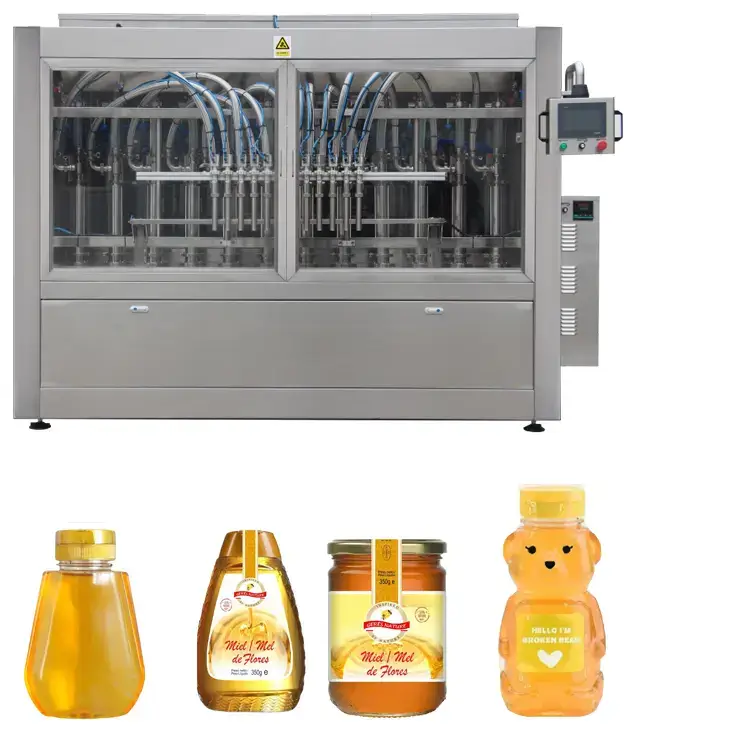
Multiple Heads Honey Filling Machine
Designed with multiple filling heads to meet different capacity requirements, making it suitable for both small-scale and high-volume production.
- Versatile Filling Technologies: Servo motor driven diving filling helps avoid foam and bubbles, while you can choose between piston and pump filling technologies depending on your process needs.
- Flexible Operation: Available with PLC control or an emotion controller for adaptable, user-friendly operation tailored to diverse production lines.
- Robust, Hygienic Construction: Built with 304SS food-grade stainless steel, with an option for 316 stainless steel for even greater corrosion resistance and durability.
- Easy Cleaning: Features a CIP (Clean-In-Place) connection system for efficient and thorough cleaning, ensuring hygiene and minimal downtime.
- Adjustable Volume Settings: Filling volume can be easily adjusted, typically accommodating a wide range—from as little as 5ml up to 1000ml—making this machine suitable for various packaging sizes.
- Manual and Automatic Options: Operators can choose between manual or pneumatic (hands-free) filling, depending on the scale and requirements of their production. Manual models offer reinforced handles for easy operation, while pneumatic models streamline the process with a simple pedal press.
- Time-Saving and Mess-Reducing: The design focuses on saving time, reducing product waste, and minimizing mess, which is essential for maintaining a clean and efficient workspace.
With its combination of precision, versatility, and robust construction, the honey jar bottle filling machine is a reliable solution for both home producers and commercial honey packagers looking to streamline their production and deliver consistently filled, attractive jars and bottles.
How to choose a honey filling machine for your bottle or jar?
When choosing a honey filling machine, match its speed and volume to your production needs, considering whether you require a manual, semi-automatic, or automatic type based on your scale of operations. Most machines offer both manual and automatic control modes for added versatility. Manual mode allows for precise, single-dose filling—typically via a foot pedal—giving you full control over each dispensing cycle. Automatic mode, on the other hand, enables continuous, hands-free operation, which is ideal for higher-volume or busier production lines where efficiency is key.
Selecting a machine with dual control modes lets you adapt easily between small-batch, hands-on work and larger, automated runs, ensuring your equipment meets your workflow as your business grows.
Tips for Maximizing Your Honey Bottle Filling Machine’s Performance
To ensure you’re getting optimal results from your honey bottle filling machine, a few best practices can make a significant difference in your daily operations.
- Choose the Right Fill Volume Settings: Select fill volumes suited to your current production. For smaller batches, set your machine for lower capacities to minimize product waste. For larger runs, use your machine’s full range—some models can accommodate 5ml up to 1000ml—to maximize throughput without frequent changeovers.
- Match the Machine to Your Product’s Viscosity: Honey’s thickness can vary by type and temperature. Be sure to adjust your filling system—whether piston or pump—for the specific viscosity of your product. If you’re working with exceptionally thick or crystallized honey, a piston-style machine or a heated fill system can maintain speed and accuracy.
- Keep Your Equipment Clean and Food-Safe: Regularly clean all parts that contact honey with the recommended solutions. Use food-grade stainless steel components (look for 304SS or a 316 upgrade) to uphold sanitation standards and prevent contamination or off-flavors.
- Monitor and Adjust for Optimal Speed: Set your filling speed to balance precision with efficiency. Slower speeds can enhance fill accuracy for premium products or small containers. For higher-volume needs, adjust the speed settings or upgrade to automated systems to keep up with demand.
- Reduce Dripping and Waste: Use anti-drip nozzles or diving filling technology to prevent product loss and ensure clean, uniform bottling. This is especially critical with honey, as its viscosity can lead to stringing or sticking.
- Simplify Operation with Intuitive Controls: If your machine offers PLC controls, pre-set batching, or one-touch operation, take advantage of these features for streamlined training and fewer errors. For facilities with changing operators, user-friendly interfaces are invaluable.
- Tailor Automation to Your Production Scale: Smaller producers may benefit from semi-automatic models, which permit flexible operation and easy product changeovers. Larger facilities should consider fully automatic machines to save on labor and increase daily output.
- Routine Maintenance Matters: Schedule regular inspections of seals, valves, and moving parts. Replacing worn components promptly avoids costly downtime and maintains fill accuracy.
By following these guidelines, you’ll maintain product quality, maximize speed, and ensure the longevity of your honey filling equipment—no matter the size or scale of your operation.
Speed and Throughput Capabilities
When evaluating honey bottle filling machines, speed and throughput are key considerations for optimizing production. These machines can generally handle fill volumes ranging from as little as 100 ml up to 1000 ml per cycle, offering flexibility for various jar and bottle sizes. Throughput rates depend largely on the type of machine you select:
- Manual Models: Manual honey bottle fillers tend to fill at a slower pace, making them well-suited for small-batch or artisanal producers where precision and hands-on control take priority over sheer volume.
- Automatic Models: For higher-demand operations, automatic honey filling machines significantly boost productivity. Many solutions are capable of filling up to 80 bottles per minute, depending on viscosity, bottle size, and product setup. This increased speed is ideal for meeting larger production targets and scaling up as your business grows.
Selecting between manual and automated systems lets producers tailor throughput to current and future production needs, ensuring both efficiency and quality remain consistent as order volumes change. This versatility means you can start small and easily scale up—switching to automated filling when your operation demands higher bottling speeds.
Typical Filling Volume Ranges
Our honey bottle filling machines accommodate a broad spectrum of filling volumes to suit diverse production requirements. Whether you’re packaging individual sample sizes as small as 5ml or large retail jars up to 5,000g, there’s a solution available. Various models offer flexible adjustment, making it easy to precisely fill everything from mini gift jars to bulk containers—all with consistent performance and accuracy. This versatility ensures you can tailor your operation to match your specific capacity needs, no matter the scale of your production.
Common Positive Feedback from Honey Bottle Filling Machine Users
When it comes to user experiences with honey bottle filling machines, several recurring themes stand out, particularly among producers who value reliability, ease of use, and efficiency in their operation.
- Adaptability Across Viscosities: Many users appreciate how these machines manage a variety of viscosities—from fluid acacia honey to thicker, crystallized varieties, and even creams or syrups. Adjustable speed and volume settings allow for seamless customization, catering to both small-batch artisans and higher throughput needs.
- Precision and Clean Operation: The anti-drip nozzle is often singled out for praise, as it significantly reduces mess and wastage by delivering smooth, precise fills. Combined with well-engineered non-return valves, the filling process remains consistent, minimizing interruptions from blockages.
- Hygienic and Robust Construction: Feedback frequently highlights the food-grade stainless steel build, which stands up to demanding production environments while ensuring cleanliness. The machines are designed for easy disassembly, simplifying cleaning and supporting compliance with food safety standards.
- Flexible Modes and User-Friendly Controls: Operators benefit from dual control options—manual for exact, hands-on dosing, or automatic for uninterrupted, high-volume runs. Intuitive interfaces mean even less experienced staff can become proficient quickly, reducing downtime and training overhead.
- Integration and Smooth Operation: The inclusion of features like reliable conveying systems ensures the filling process remains smooth, supporting a range of container sizes and types without hassle.
Overall, Npack honey filling machines are recognized for delivering versatility, consistent quality, and operational efficiency—key reasons why producers from boutique beekeepers to commercial manufacturers continue to rely on them for their honey packaging needs.
Related Types of Filling Machines for Other Products
Filling machines designed for honey are often quite versatile and can handle a variety of other viscous and liquid products with minimal adjustments. Depending on the application, these machines can be equipped to fill a wide assortment of substances, ranging from thick creams to free-flowing liquids. Here are some of the main types and their typical uses:
- Paste and Cream Fillers: Ideal for products like lotions, shampoos, face creams, and cosmetic gels. These machines typically use piston or pump technology to manage thicker consistencies, ensuring a clean and accurate fill.
- Liquid Fillers: Suitable for less viscous products such as juices, oils, water, and liquid detergents. Many of these fillers employ gravity or gear pump systems, allowing for precise volume control and adaptation to various container shapes.
- Weighing and Digital Control Fillers: Commonly used for edible oils, sauces, and even wine. These machines rely on digital scales or sensors to ensure each bottle or pouch receives exactly the right amount, which is essential for batch consistency and quality control.
- Pneumatic Filling Machines: Great for medium- to high-volume operations, these units harness compressed air for effortless filling, making them perfect for repeated cycles in food and cosmetic manufacturing.
- Manual and Semi-Automatic Fillers: Well-suited to smaller production lines or artisanal operations. They provide a balance of control and ease, making them versatile for products ranging from essential oils and honey to hand creams and small-batch beverages.
In summary, the same robust, hygienic, and adjustable machinery that excels with honey can also handle oils, juices, detergents, creams, and a whole range of viscous or free-flowing products. This flexibility makes them a smart investment for producers looking to diversify their product lines or streamline filling operations.